Job postings rarely define what they mean by AI-related requirements, and the terms used vary widely between employers, industries, and even between two listings at the same organisation. Phrases like “AI-fluent,” “AI-first mindset,” and “comfortable with AI tools” appear in roles from marketing coordinator to senior analyst, often with no additional context and no indication of which tools the company actually uses. Understanding what these signals mean — and what they almost never mean — helps candidates respond accurately rather than over- or under-representing their experience.
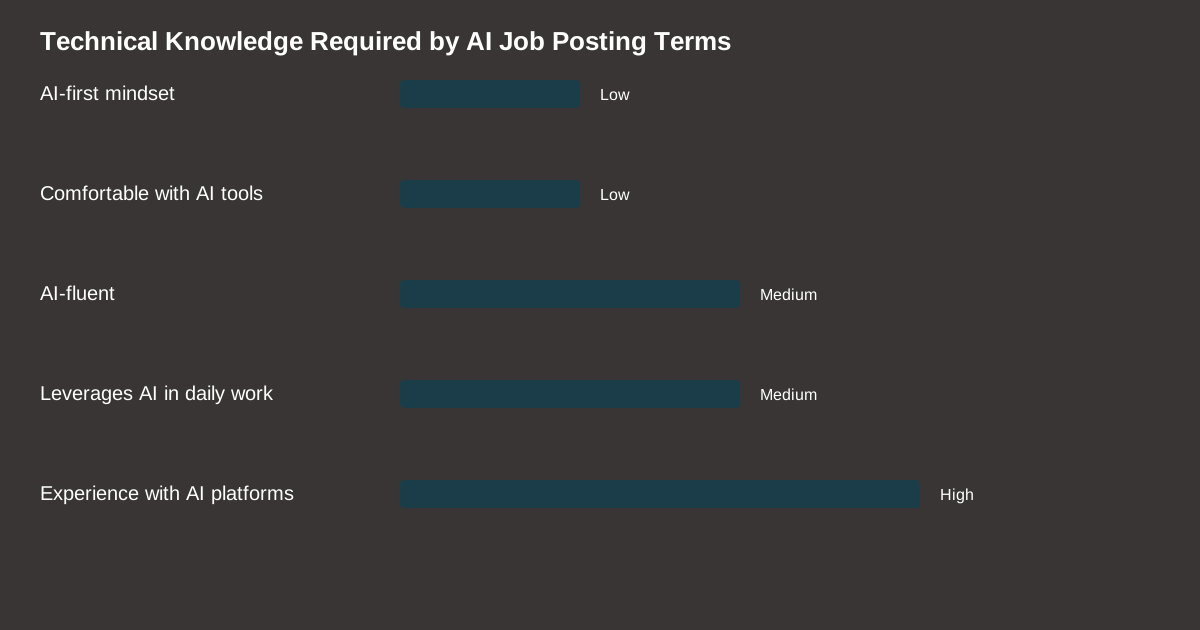
Most AI-related requirements in job postings signal cultural fit and basic tool openness, not technical expertise. "AI-fluent" typically means comfortable using AI tools as part of a workflow, not building or training models. Candidates who can describe specific ways they have used AI tools in real work are generally better positioned than those who lead with certification names alone.
What Does “AI-Fluent” Actually Mean in a Job Posting?
In the vast majority of non-technical job listings, “AI-fluent” is a tool-familiarity signal rather than a technical credential. It typically means the employer expects a candidate to pick up AI-powered software quickly, integrate it into an existing workflow without hand-holding, and approach AI outputs with enough critical judgment to refine them before they go anywhere important. The specific tools may or may not be named in the listing, and they are often tools the employer itself is still evaluating.
What “AI-fluent” almost never means in a non-technical posting: experience training machine learning models, working with developer APIs, or writing code that involves AI components. Those requirements appear under different and more specific labels — “experience with ML frameworks,” “comfort with Python,” platform names like Databricks, or references to model fine-tuning and evaluation. If those terms do not appear in the listing, the AI-fluent requirement is almost certainly describing tool literacy, not engineering proficiency.
A candidate who uses AI tools regularly to streamline their work — drafting, research, data summarisation, client communication, or project planning — already meets most versions of “AI-fluent” as used across non-technical roles. The issue is usually not whether the experience exists but whether the candidate has described it clearly in application materials.
What Does “Comfortable with AI Tools” Actually Signal?
This is the lowest bar on the AI-requirement spectrum, and understanding it as such prevents candidates from either ignoring it or over-preparing. “Comfortable with AI tools” typically signals that the employer is using or planning to use AI tools in the workflow and does not want to onboard someone who will resist or be slowed by that adoption. It is an openness signal, not a competency requirement with a defined threshold.
Many employers who use this phrase are themselves in early or mid-stage AI adoption. They are signalling a cultural preference — candidates who approach new tools with curiosity and reasonable flexibility, rather than skepticism or friction. Demonstrated experience with specific tools is welcome and differentiated, but a formal credential is rarely what the posting is filtering for.
In practice, a candidate who has used any major AI-powered tool — a writing assistant, an AI search tool, a transcription or summarisation platform — in a work or project context can honestly claim this characteristic. The bar is tool exposure with a positive disposition, not a portfolio of AI projects.
What Does an “AI-First Mindset” Require?
“AI-first mindset” is primarily a cultural requirement, and it is a more meaningful signal than the other terms on this list. It indicates that the organisation has made an internal commitment to AI adoption and wants new hires to accelerate rather than drag on that trajectory. Candidates who use AI tools sporadically or reluctantly will likely struggle in environments where AI integration is a stated priority, regardless of their performance on other dimensions.
The practical implication: employers looking for an AI-first mindset value demonstrated examples over general enthusiasm. A story about a specific workflow problem, an AI tool that addressed it, and what the output looked like before and after is more compelling than “I’m excited about AI’s potential.” The former shows habit and judgment; the latter shows awareness.
This phrase also often signals that the team or manager asking for it has strong opinions about how AI tools should and should not be used. Candidates who can discuss not just when they use AI but when they choose not to — because the task requires original judgment, a human relationship, or quality that AI cannot reliably produce — tend to stand out as more sophisticated than those who describe AI as universally useful.
Do These Requirements Mean a Role Involves Technical AI Work?
For the vast majority of non-technical roles where these phrases appear, no. A content strategist, operations manager, HR business partner, or account lead who encounters AI-related language in a job description is usually reading a cultural-fit and tool-openness signal, not a specification for AI development skills.
Technical AI roles carry plainly different language — specific frameworks, model types, programming languages, and platform certifications. When those terms appear, they are requirements. When only culture-and-fluency language appears without them, the bar is tool literacy and orientation, not engineering or data science background.
Candidates from non-technical backgrounds sometimes assume that AI requirements in a posting are aimed at people with technical education and pass over listings they would otherwise be competitive for. That assumption misreads the signal in most cases and leads to unnecessary self-disqualification.
How Should a Candidate Address These Requirements?
The strongest response to any AI-related job requirement is a specific, grounded example from actual work, not a declaration of enthusiasm or a certification name. What task involved AI? Which tool was used? What did the output look like, and how did the candidate’s judgment improve it?
That structure — task, tool, outcome — is what most hiring managers mean when they screen for AI fluency. It answers the question behind the requirement (can this person use AI in a way that makes them more effective?) more directly than any credential or self-assessment can.
Candidates who have not yet built a track record of AI tool use at work often find the most practical path is to start using available tools on current projects, then document what changed. Workers who want to formalise that process and build internal credibility at the same time may find it useful to understand how to ask for AI tool access at work in a way that generates real projects to reference later.
Reading AI job requirements with the cultural-versus-technical frame — openness signal versus engineering credential — turns vague language into something directly actionable. The candidates who consistently meet these requirements are those who have been using AI tools on actual work, not those who have studied the terminology in the listing most carefully.